Speech Therapy For Parkinson’s Disease: How LSVT LOUD Can Improve Communication
Speech therapy for Parkinson’s disease helps people speak louder, clearer, and with more confidence. Parkinson’s disease, a progressive neurological disorder that affects movement and muscle control, can impact the muscles used for speech and swallowing, affecting communication. However, evidence-based programs like LSVT LOUD® directly address these challenges and can significantly improve communication, confidence, and quality of life.
Dianne Warns, MS, CCC-SLP, a Speech-Language Pathologist at Clermont Park, has delivered speech therapy for Parkinson’s disease using LSVT LOUD since becoming a certified clinician in the therapy in 2016. In her experience, this evidence-based program consistently improves vocal strength, clarity, and overall communication—while also boosting confidence and emotional well-being.
Dianne has seen first hand how speech therapy for Parkinson’s disease can transform daily life. Her experience highlights a key outcome of LSVT LOUD: when individuals regain their voice, they often reconnect socially, communicate more effectively, and feel more confident in everyday interactions.

What Is Parkinson’s Disease?
Parkinson’s disease (PD) is a progressive neurodegenerative disorder characterized by the degeneration of dopamine-producing neurons in the region of the brain crucial for movement control. This loss of dopamine leads to the characteristic symptoms of Parkinson’s, including:
- tremors at rest
- bradykinesia (slowness of movement)
- muscle rigidity
- postural instability
Although most people associate motor impairment with Parkinson’s disease, non-motor symptoms can also be present in patients and can significantly affect quality of life:
- depression
- cognitive decline
- sleep disturbances
- autonomic dysfunction (e.g., constipation, orthostatic hypotension)
For more information, visit the Parkinson’s Foundation and the National Institute of Neurological Disorders and Stroke.
How Does Parkinson’s Disease Impact Speech?
One less visible yet profoundly impactful symptom of Parkinson’s Disease is its effect on speech and language. Speech therapy for Parkinson’s disease is essential because communication changes are both common and progressive.
Many individuals develop hypokinetic dysarthria, a motor speech disorder that causes a soft, monotone, and rigid-sounding speech pattern, making it difficult for others to hear and understand. This can make communication challenging and frustrating for individuals with the disease.
Dianne explains that a “feedback mismatch” can also be present with individuals with Parkinson’s, meaning a person may think they are speaking loudly enough when their voice is actually speaking very softly. Or, they may perceive that they are speaking loudly or shouting when they are speaking at a volume that sounds normal to those around them.
Other speech-related issues include reduced facial expressiveness, which can diminish the nonverbal aspects of communication, and difficulties with articulation, which may cause speech to become slurred. These communication challenges necessitate tailored speech therapy interventions to help individuals maintain their ability to communicate effectively.
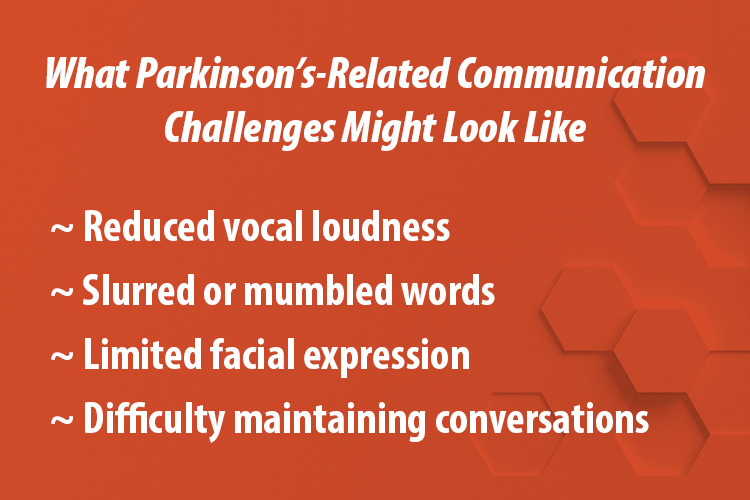
What communication challenges should families recognize early?
- Reduced vocal loudness (hypophonia, meaning soft speech)
- Slurred or mumbled words
- Limited facial expression
- Difficulty maintaining conversations
These are critical issues because without intervention, these challenges can lead to social isolation.
How Does LSVT LOUD Speech Therapy Work?
LSVT LOUD (Lee Silverman Voice Treatment) is a specialized speech therapy for Parkinson’s disease that focuses on increasing vocal loudness and improving clarity.
Why is LSVT LOUD considered the gold standard treatment?
Developed by Dr. Lorraine Ramig, LSVT LOUD is backed by decades of research and clinical success. It trains individuals to recalibrate their perception of loudness so their voice is more audible and understandable to others, while also prioritizing breath support and facial expressiveness.
At Clermont Park, Dianne Warns has been an LSVT LOUD Certified Clinician since 2016 and has seen meaningful improvements in residents’ communication and confidence.
“The key to this being effective is ‘think loud.’ That is my phrase. If I’m using my loud voice, everything changes. My appearance changes, my facial expression changes, my intelligibility improves. I have slowed my rate of speech down a little bit to be more loud. All of this by saying, ‘think loud.’”
Dianne Warns, MS, CCC-SLP
This video from LSVT LOUD beautifully demonstrates the powerful transformation that this therapy can have on one’s communication.
Reflecting on her experience with a specific client she worked with, Dianne shares:
“She changed my life as a clinician. To see the change and effect that LSVT LOUD had on her, it was so surprising to me.”
Three core strategies of LSVT LOUD for effective treatment
- Target: Vocal Loudness (or amplitude) – This is built around evidence-based strategies for the brain’s ability to learn and change (neuroplasticity).
- Mode: Intensive Dosage and High Effort – Consistency, intensity, and high effort are key to clients achieving greater success through this therapy.
- Calibration: Generalization – This involves moving from the therapy room to the outside world and adjusting sensory feedback to recognize that one’s loud voice is within a normal range for those listening. “Clients have to feel that effort that they’re using, that perceived effort,” explains Dianne, to know that they are speaking within an audible range.
How Does a Client Qualify for LSVT LOUD Treatment?
Before beginning LSVT LOUD, patients must complete an evaluation with an Ear, Nose, and Throat (ENT) specialist. The ENT examines vocal cord function and checks for issues like nodules, bowing, or other abnormalities.
Once cleared, a physician provides a referral for treatment with an LSVT LOUD certified clinician.
What Do LSVT LOUD Therapy Sessions Look Like?
LSVT LOUD consists of four weeks of intensive, high-effort sessions. Additionally, daily homework exercises are essential to experiencing the full benefits of treatment. Throughout therapy, an emphasis is placed on good vocal quality to be sure that one isn’t straining their voice or damaging their vocal folds in the process.
What does the evaluation process include?
Dianne begins each LSVT LOUD® program with a comprehensive evaluation to establish a clear baseline of the client’s speech. This starting point allows her to track measurable progress over the four-week course of speech therapy for Parkinson’s Disease. She uses a sound level meter to measure speaking volume in decibels and evaluates how long a client can sustain an “ahh” sound, which helps assess vocal strength and control.
Dianne will also do a cognitive assessment and assess any difficulty swallowing, which is common for those with Parkinson’s Disease. She also asks both the client and a loved one to share their perspective on current communication challenges to better understand real-life impact.

During the first session, Dianne collaborates with each client to create personalized, everyday phrases that will be practiced throughout therapy. As she explains: “In that first session, I’ll have the client help me create ten functional phrases that they will typically use every day. This could be, ‘Good morning,’ ‘Hi, my name is Bob,’ or ‘I need to take the dog for a walk.’ It can’t be too long or too short.”
Evaluation:
- Voice volume (measured in decibels)
- Breath support
- Swallowing ability (dysphagia, meaning difficulty swallowing)
- Cognitive communication skills
What do therapy sessions look like?
LSVT LOUD includes 16 sessions over four weeks:
First half of sessions focus on:
- Sustained vowel sounds (“ahh”)
- Pitch exercises
- Repetition of functional phrases
Second half progresses weekly:
- Week 1: Single words and short phrases
- Week 2: Sentences
- Week 3: Reading aloud
- Week 4: Conversational speech
Therapy is tailored to personal interests—like reading golf magazines or discussing hobbies—to make it engaging and relevant.
Why Is Daily Practice Critical for Success?
Consistent practice reinforces progress and builds long-term habits.
What role does homework play in therapy?
Patients complete short daily exercises:
- 5–10 minutes on therapy days
- 10–15 minutes twice daily on non-therapy days
This repetition strengthens muscle memory and improves speech consistency.
How does practice impact long-term outcomes?
- Maintains speech improvements
- Slows decline in communication ability
- Builds confidence in real-world conversations
As Dianne emphasizes, incorporating exercises into daily routines—like practicing after brushing teeth—helps make progress sustainable.

How Does Speech Therapy for Parkinson’s Disease Improve Confidence and Social Connection?
In the ten years that Dianne has been an LSVT LOUD Certified Clinician, she has seen this treatment improve the quality of life of many clients. Speech therapy for Parkinson’s disease can restore more than just voice—it can rebuild confidence and relationships.
Dianne recalls one powerful example:
“This client noticed a change in her voice and she started socially isolating herself. She was not talking on the phone with her best friend, who lived in another state. She was shutting down. She wasn’t going out.”
After completing LSVT LOUD therapy, the transformation was clear:
“It was life-changing for her. She started calling her friends again… she started going on more outings.”
Support for Individuals with Parkinson’s Disease at Clermont Park
Speech therapy for Parkinson’s disease is one of the most effective non-medication treatments available today. With the right support—and guidance from experienced clinicians like Dianne Warns—individuals can maintain their voice and stay connected through every stage of their journey.
Dianne is part of a multi-disciplinary team at Clermont Park that also includes physical and occupational therapists. This award-winning team specializes in treatment for older adults, including those with Parkinson’s Disease, whether on a short-term basis in our Rehabilitation neighborhood or on a long-term basis in our Skilled Nursing neighborhood.
We invite you to contact us or visit our University Hills senior living community to learn more about how Clermont Park can support you.