For many older adults and their families, choosing a senior living community isn’t just about care; it’s about lifestyle, autonomy, and belonging. Over the past several decades, senior living has evolved significantly, moving away from institutional models toward approaches that prioritize resident voice and choice.
You may hear communities describe themselves as resident-directed or resident-driven. At Clermont Park, those ideas remain foundational, but they are not the finish line. Instead, the community has embraced a broader, deeper philosophy known as citizenship, which builds on resident-driven practices and expands them into a culture of shared purpose, influence, and contribution.
Understanding what that means—and why it matters—can help families better envision what life at Clermont Park truly looks like.

Resident-Driven Cultures: A Familiar Starting Point
Resident-driven, sometimes called resident-directed, senior living represents an important shift from traditional top-down models. In these cultures, residents are not passive recipients of care or programming. Instead, they are encouraged to make choices about their daily lives and participate in shaping the community around them.
In resident-driven communities, this often includes the following:
- Choice in daily routines, such as meals, activities, and schedules
- Opportunities to provide feedback through councils, surveys, or forums
- Programs and events shaped by resident interests and preferences
- A focus on dignity, respect, and personal autonomy
These practices help ensure that residents feel heard and supported as individuals. For many communities, resident-driven culture represents meaningful progress—and it is.
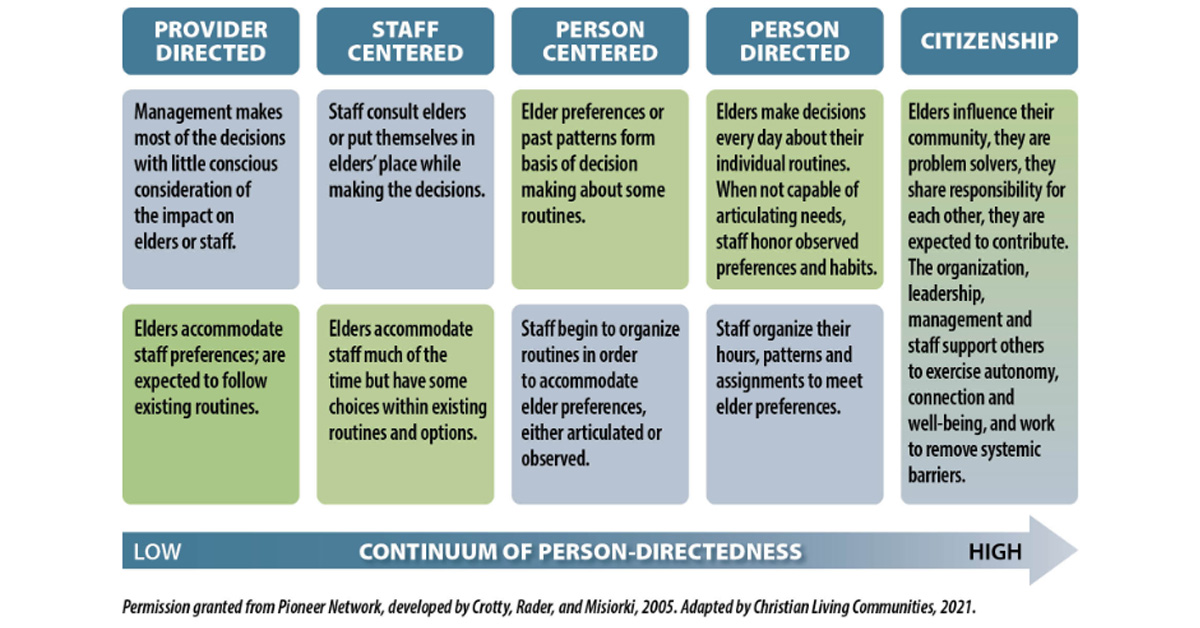
However, resident-driven models can still place limits on influence. Decisions may ultimately rest with staff or administration, with residents offering input rather than exercising shared authority.
Enter, citizenship.

Citizenship In Senior Living: A Step Beyond Resident-Driven
Citizenship in senior living builds on resident-driven principles but expands them into something more participatory and relational. Rather than focusing solely on choice, citizenship emphasizes belonging, responsibility, and shared ownership of community life.
In a culture of citizenship, residents are not just consulted; they are collaborators. They are recognized as whole people with talents, passions, histories, and perspectives that actively shape the community.
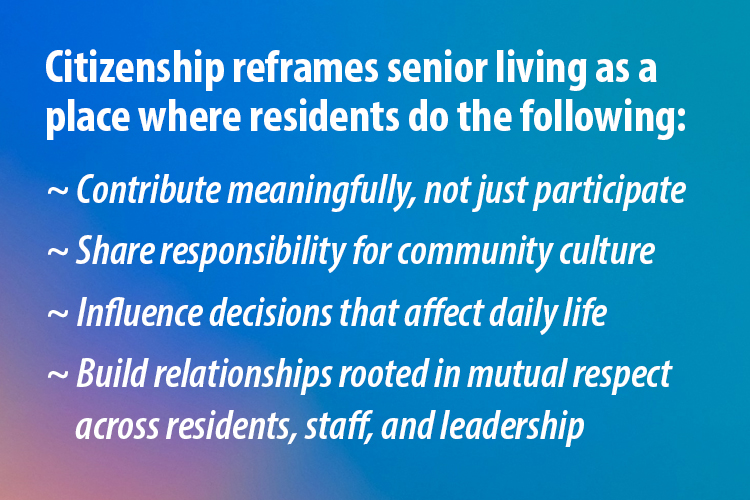
Citizenship reframes senior living as a place where residents do the following:
- Contribute meaningfully, not just participate
- Share responsibility for community culture
- Influence decisions that affect daily life
- Build relationships rooted in mutual respect across residents, staff, and leadership
This approach recognizes that autonomy alone is not enough. Purpose, connection, and contribution are equally essential to well-being—whatever your stage of life.
At Clermont Park, citizenship is not a slogan. It is a living framework that informs how the community listens, learns, and grows together.
Why Citizenship In Senior Living Matters
The move toward citizenship reflects a deeper understanding of what supports quality of life as people age. Research and lived experience consistently show that older adults thrive when they feel valued, connected, and useful—rather than managed or sidelined. A sense of purpose, meaningful relationships, and opportunities to contribute are strongly linked to better emotional health, cognitive engagement, and overall well-being in later life.
When older adults are treated as active participants in their communities, rather than passive recipients of services, they are more likely to remain engaged, resilient, and fulfilled. Citizenship-centered approaches recognize that aging reminds us not to withdraw from community life, but to remain part of it in ways that continue to matter.
- It strengthens purpose. Residents continue to shape their environment, rather than adapting to one designed for them.
- Citizenship builds authentic community. Relationships are based on mutual respect, not roles or hierarchies.
- It supports emotional well-being. Feeling heard and influential reinforces dignity and self-worth.
- Citizenship encourages engagement. When people help shape their community, they are more invested in it.
For families, citizenship offers reassurance that their loved one will be seen not just as a resident, but as a person whose voice and contributions matter.
What Citizenship Looks Like At Clermont Park
Citizenship at Clermont Park is woven into daily life, long-term planning, and community relationships. It does not replace resident-driven practices: It deepens them.
Here are some of the ways citizenship takes shape in practice.
Shared Influence And Decision-Making
Residents at Clermont Park have meaningful opportunities to influence how the community evolves. This goes beyond offering opinions to actively shaping outcomes through dialogue, collaboration, and trust.
Residents contribute to conversations about the following:
- Community norms and values
- Programs and initiatives
- How shared spaces are used
- How the community responds to change
This shared influence reinforces the idea that Clermont Park is not simply a place to live. It is a community that residents help steward.
Honoring Individual Passions And Strengths
Citizenship recognizes that every resident brings a lifetime of skills, interests, and experiences. At Clermont Park, residents are not expected to leave those passions at the door. Instead, they are invited in and celebrated.
Residents regularly enrich community life through:
- Sharing talents, knowledge, and leadership
- Initiating clubs, interest groups, or projects
- Mentoring peers or engaging across generations
- Helping shape programs that reflect real interests
This approach affirms that contribution does not diminish with age; it simply takes a different form.
A Culture Shaped By The Eden Alternative®
Clermont Park’s citizenship model is closely aligned with the principles of the Eden Alternative®, which emphasize combating loneliness, helplessness, and boredom through meaningful relationships and engagement.
This philosophy supports:
- Deeper connections between residents and staff
- Environments that feel alive, responsive, and human
- A shared commitment to growth, curiosity, and compassion
Citizenship and the Eden Alternative work together to create a culture where people matter—not just processes.
A Community Where Voice, Purpose, And Belonging Endure
For those exploring senior living, terms like “resident-directed” and “resident-driven” can signal positive change—and they should. But at Clermont Park, the vision extends further. Citizenship reflects a belief that aging does not diminish a person’s role in community life. Instead, it offers new opportunities for contribution, leadership, and connection.
By embracing citizenship as a step beyond resident-driven culture, Clermont Park creates an environment where residents are not simply cared for. They are respected, engaged, and empowered to continue shaping the world around them.
Contact us to schedule a tour or to learn more about how Clermont Park’s resident-driven culture and citizenship model create a community where older adults continue to belong, contribute, and thrive.